When the CEO Falls Asleep
A tale about a 5-MeO-DMT experience
Originally published on Substack.
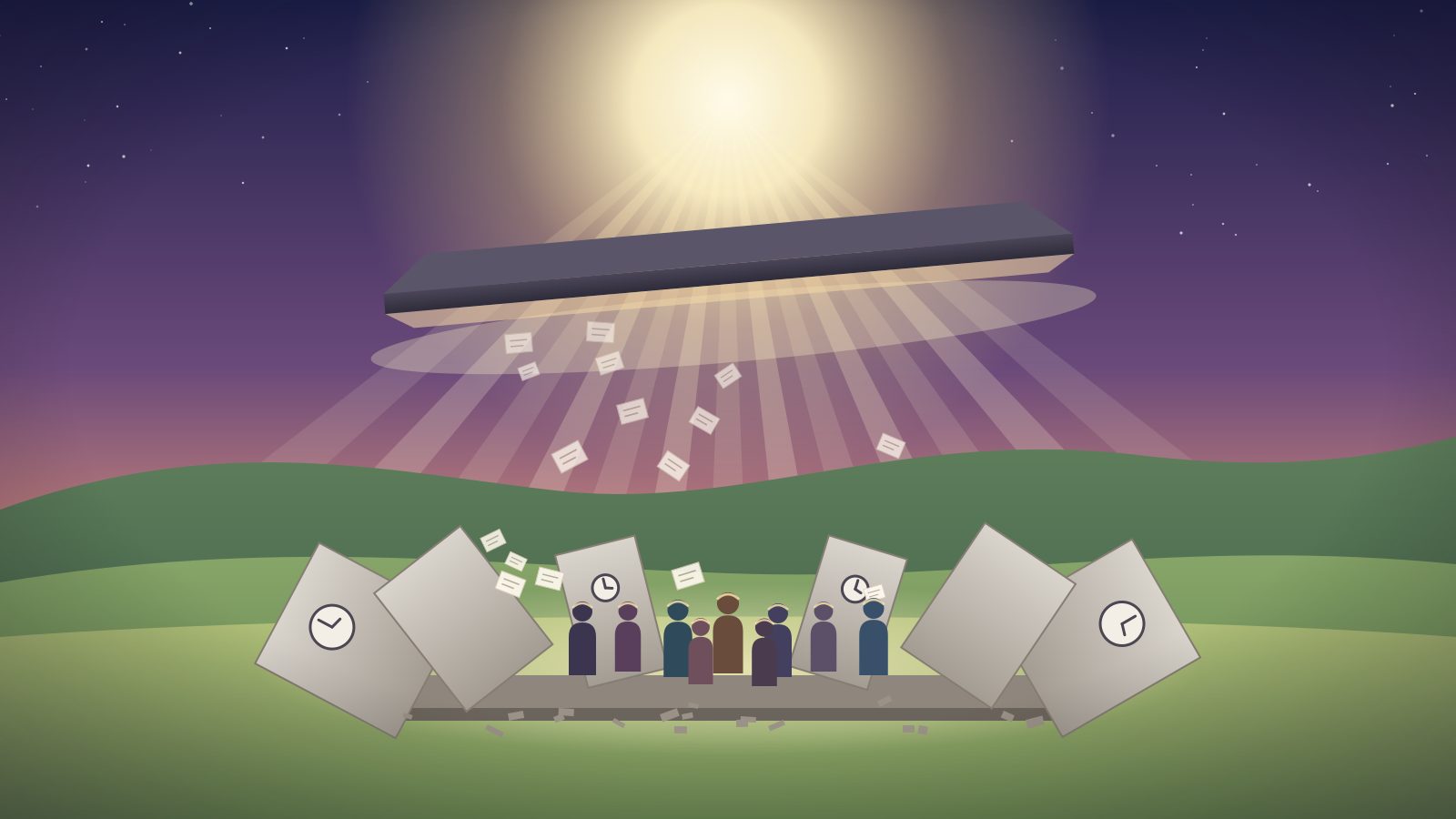
Some people come back from a 5-MeO-DMT session with no words at all. Others come back with a parable.
Mike came back with an office building.
He told it to me shortly after his session, haltingly, circling back twice because he'd forgotten pieces that turned out to matter. I've kept his story as close to how he told it as I could, because the way it arrived — searching, unfinished, a little surprised at itself — is part of what it has to teach.
The building
There is an office building. Inside it are a great many offices. Some hold a few people. Some hold just one.
The building is run by a CEO, and he runs it strictly. Every office door stays closed. There are no windows. The people inside don't talk to each other.
Instead, communication happens through notes. A message is written, folded, and slid under a door. In the hallways, messengers walk back and forth, collecting the notes and delivering them to whichever office they're meant for.
It is an orderly system. Nobody sees anybody. Everything goes through the hallways.
Two notes, two doors
This was the first thing Mike went back for.
In one office sits a man alone. Twenty years ago, a note came under his door. It said, more or less: Watch out for the bad man.
No other message ever came. For twenty years, that note was the only news he had of the world outside his room. So he kept watching out.
In another office, four people work together. Thirty years ago, a note slid under their door: We don't like your work. We don't like what you make. We don't even like your office.
That was the last message they received. Thirty years of silence after it. So that is what they believe about themselves.
The clock
This was the second thing he went back for.
On a wall in every office hangs a huge clock. You can hear it ticking. It is impossible to ignore. Time is very present in every room — and yet in every room, the most important message is decades old.
I find this detail quietly devastating. The clock insists that time is passing. The note on the floor insists that nothing has changed.
The CEO falls asleep
Then, one moment, the CEO falls asleep.
And as he does, the walls of the offices begin to tumble down. The roof lifts off the building. Suddenly everyone who had been sealed into their separate rooms is standing together, outside, in nature, under an enormous light.
And for the first time, they can talk to each other directly. No notes. No messengers. No doors.
The man who had been alone finds people from the other offices, and he tells them: Twenty years ago I got a message. Watch out for the bad man.
And they say to him, gently: That was twenty years ago. The bad man is long gone. You don't have to be afraid anymore.
The four people from the other office share their message too — the one about their work not being liked, their office not being liked. And they are told the same thing: That was from a long time ago. It isn't true anymore.
What follows, as Mike described it, is a kind of joyful clearing. Conversations full of relief. Things resolving. Things releasing. People who had been carrying a single sentence for decades, finally setting it down.
What the story is pointing at
Mike's office building is a remarkably good picture of what many people describe on 5-MeO-DMT.
In ordinary waking life, much of what we feel is handled by a kind of executive management — the brain's top-down control systems, a lot of which run through the prefrontal cortex. This manager is extremely useful. It plans, filters, prioritises, keeps us functional. It also keeps things compartmentalised. Emotions and old experiences get filed into separate rooms. They communicate, but indirectly — through the hallways, through notes, through the slow and sometimes distorted relay of habit and interpretation.
Research into 5-MeO-DMT is still young, and "the prefrontal cortex shuts off" is a simplification. But brain imaging of powerful psychedelics consistently shows that the usual organisation of the brain's networks loosens dramatically — including the regions most associated with self-control, self-narrative and keeping things in their place. Subjectively, people often describe exactly what Mike saw: the manager stepping away, and emotion coming first.
When that happens, the old messages are no longer read in isolation. They're met by everything else we know — by the parts of us that have lived through the twenty or thirty years since. The frightened part meets the part that knows the danger has passed. The rejected part meets the part that knows the criticism was one voice, long ago.
Nobody in the story argues anyone out of anything. Nobody forces a resolution. The walls simply come down, and the truth is allowed to travel directly, in the light, person to person.
The CEO wakes up
And then, as Mike put it, the CEO starts waking up.
Slowly, the offices are put back together.
This is the part I keep thinking about, because it's honest. The walls don't stay down. The manager returns — as he should. We need him. Nobody can live permanently outside in the light with no structure at all.
But the building isn't quite the same. The man in his office now knows the bad man is gone. The four people in theirs now know that the message from thirty years ago was just that: a message from thirty years ago. The doors may close again, but what was said in the open doesn't get unsaid.
The real work — what we call integration — may simply be this: learning to leave a few windows in. Letting the people in the different rooms keep talking, even once the CEO is back at his desk. And noticing, the next time an old note shows up on the floor, that the clock on the wall has been ticking all along.
The rest of the story
When I asked Mike how it ends, he paused.
I don't know the rest of the story yet, he said.
I can't think of a better ending.